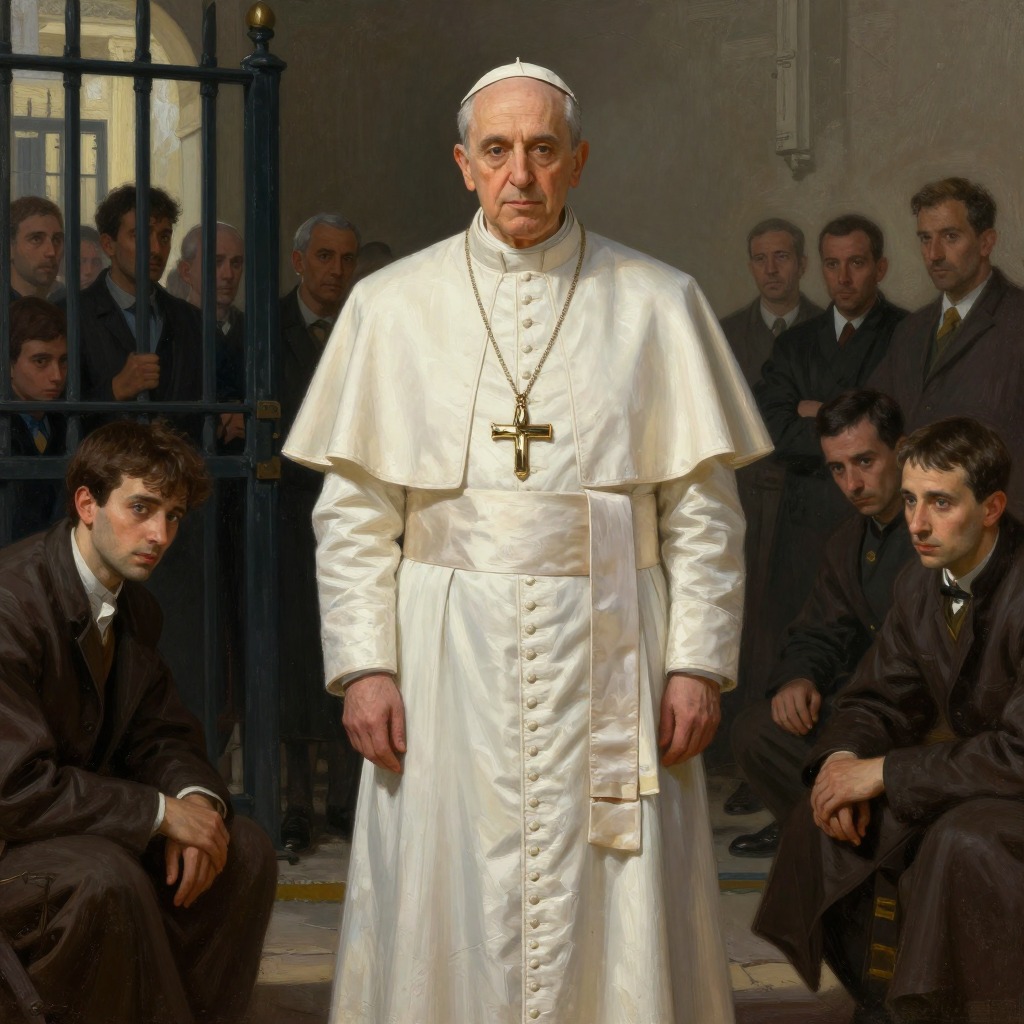
The pope
The pope is a symbolic office that Jean-Baptiste Clamence briefly holds during his internment in a prison camp near Tripoli in North Africa, an episode that becomes a crucial turning point in his moral self-understanding and a direct precursor to his later invention of the judge-penitent. The role is thrust upon him not by any ecclesiastical authority but by the desperate, quasi-religious logic of a camp full of suffering men, and Clamence's acceptance of it—at first a joke, then increasingly serious—reveals the deep structure of his character: a hunger for dominance that can be satisfied only by being acknowledged as the most guilty among the guilty. The experience teaches him that power and moral authority are born from shared wretchedness, and it provides the template for the confessional tyranny he will later practice in Amsterdam.
Election and Investiture
The camp where Clamence is held is a place of extreme deprivation: heat, vertical sun, flies, sand, and lack of water. Among the prisoners is a young Frenchman of the "Du Guesclin type"—a Catholic idealist who had crossed into Spain to fight, was interned by the Catholic general, and developed a profound melancholy after seeing that the Franco camps were "blessed by Rome." This man, half-unhinged by the sun and his reflections, declares the need for a new pope who would live among the wretched instead of praying on a throne. He asks the group to choose a man with the most failings, and Clamence, as a joke, raises his hand—the only one to do so. The young prophet declares that nominating oneself presupposes the greatest virtue and proposes electing Clamence. The others agree, "in fun, but with a trace of seriousness all the same." Clamence exercises his pontificate for several weeks, with increasing seriousness.
The Nature of the Pontificate
Clamence's role as pope is essentially that of a group leader or secretary of a cell. The other prisoners, even those who lacked faith, get into the habit of obeying him. The big problem in the camp is the water allotment, and Clamence is led to favor his own comrades—a first concession. Even among his own group, he cannot maintain complete equality; according to a comrade's condition or the work they have to do, he gives advantages to one or another. He discovers that such distinctions are far-reaching. The decisive moment comes when he drinks the water of a dying comrade, convincing himself that the others need him more than this fellow who is going to die anyway and that he has a duty to keep himself alive for them. This act, he reflects, is how empires and churches are born "under the sun of death."
Significance and Aftermath
The pontificate episode provides Clamence with a lived experience of how authority is constructed from guilt and sacrifice. He learns that to be a leader is to be the one who has committed the worst transgression—drinking the water of a dying man—and then to justify it as a necessity. This directly prefigures his later profession of judge-penitent, in which he accuses himself in order to earn the right to judge others. The episode also gives him a new understanding of the pope in Rome: "My great idea is that one must forgive the pope. To begin with, he needs it more than anyone else. Secondly, that's the only way to set oneself above him." The camp pope, like the later judge-penitent, is a figure who dominates by being the most compromised, the most guilty, and the most willing to confess.